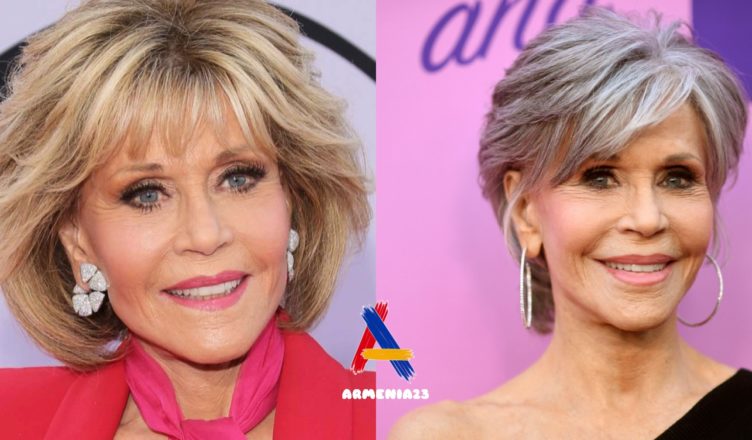
Jane Fonda freely acknowledges that she has not always been the best mother to her three children, but that she is making amends in the present.
An interview with the actor titled “Who’s Talking to Chris Wallace?” aired on February 17 and revealed this information.
Fonda, who has three kids (Mary Williams, 55, Vanessa Vadim, 54, and Troy Garity, 49), admitted to the host
that she ’was not the kind of mother that I hoped that I had been to my children.’ Both of my children are exceptionally talented and bright.
And I had no notion whatsoever how to go about achieving it. She went on to remark, ‘I’ve studied
parenting, and I know what it’s meant to be now,’ as she began to explain. At the time, I had no notion. I’ll therefore attempt to show up.
In a previous interview for the Call Her Daddy podcast, Fonda expressed her regret over all of the challenges
and difficulties she had when she was younger. ‘Growing up is such a difficult journey. Don’t fall for anyone’s lies, she said.
‘Just what am I supposed to be doing here? Who specifically am I supposed to know? ‘Who precisely am I supposed to become?’
‘What exactly am I supposed to be interested in?’ But, she did say that as one ages, some ideas become clearer.
‘The majority of the obstacles that I’ve encountered in my life occurred earlier in my life,’ the musician continued.
I had an extremely severe case of anorexia. I was leading a double life, felt overwhelmingly miserable, and believed I wouldn’t live past the age of 30. I’m 85.’
The aerobics enthusiast also talked about how her life changed when she stopped trying to ‘push through’ those challenging times by herself
and started relying on and opening up to others around her. This was earlier in the episode when she first started to depend on and open up to those around her.
‘I considered that to be a serious flaw. My urge to seem more macho has always been a constant.
I’d say something like, ‘I don’t need anyone. ‘When I was younger, and by younger I mean in my 30s, 40s, 50s, and 60s,
independence was the defining characteristic of an adult,’ she continued. I don’t require anybody. I’m an adult now. We were not acknowledged as being dependent on one another.
Of course, this was especially true for men. Despite the fact that this was established in society, things started to change in this area.
My transition was therefore part of a larger cultural shift. Unfortunately, I fear that this change is being reversed,
returning to a time of rugged individualism and ‘I’m just going to worry about myself and my family” mentality.
And if there was ever a time when we needed to understand how connected we are to one another and how important it is for us to cooperate, now is it.