
It has long been hypothesized that implants could link prosthesis to the brain in a way that causes electrical signals to stimulate directives from the neurological system.
Given that one man who is paralyzed from the hips down can walk alone, even up stairs, thanks to such
electrical nerve stimulation, this concept is now closer than ever to meaningful implementation.
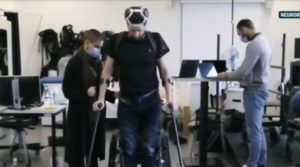
Gert-Jan Oskam, the patient, had a spinal cord damage in a motorcycle accident and is now completely paralyzed from the waist down.
Oskam participated in a proof of concept study to potentially make more advancements after using a precursor technology to regain some mobility.
In the past, he had to elevate his heel to cause an implant in his spinal cord to send a series of electrical
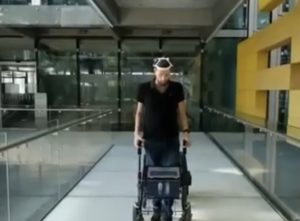
impulses that allowed him to move his legs. However, it was cumbersome and difficult to use on uneven terrain.
Oskam said of his new apparatus: ‘The stimulation before was controlling me, and now I’m controlling the stimulation.’
Oskam now has a pacemaker implanted in his belly that determines how much electricity to give to it when he thinks about moving his legs by sending a signal to a backpack-mounted computer.
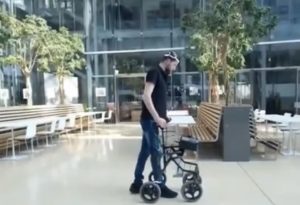
It then transmits a message to the more seasoned implant in his spinal cord, causing his legs to move more subtly. A helmet with antennae aids in signal coordination.
According to the scientists working on the technology and with him, he can stand unsupported for two to three minutes and walk about 200 meters every day.
Oskam describes a day when he needed assistance painting but no one was available. He simply took his crutch and performed it himself thanks to modern technology.

The ‘digital bridge’ represents a significant achievement in the field of nervous system stimulation technology,
and the scientists intend to use it to deal with patients who have paralyzed arms and hands as well as survivors of stroke in the future.