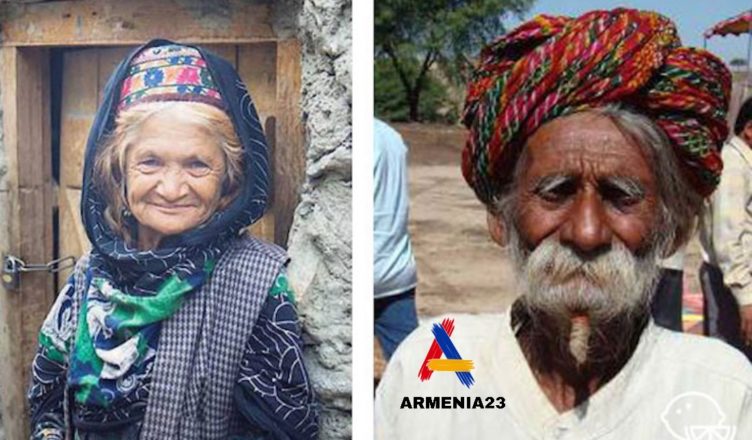
There is a certain way of life approaching the ideal, when people feel healthy, happy, and do not age.
The valley of the Hunza River (the border between India and Pakistan) is called ‘the oasis of youth’.
The life expectancy of the inhabitants of this valley is 110-120 years. They almost never get sick and look young.
This means that there is a certain lifestyle approaching the ideal, when people feel healthy, happy, and do not age, as in other countries, at the age of 40-50.
It is interesting that the inhabitants of the Hunza Valley, unlike the neighboring peoples, are very similar in appearance to Europeans (like the Kalash, who live very close).
According to legend, the hill state here was founded by a group of soldiers from Alexander the Great’s army during his Indian invasion.
Naturally, they imposed strict military discipline here, such that the inhabitants with swords and shields had to sleep, eat and even dance…
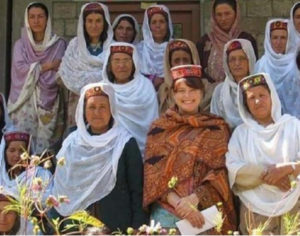
At the same time, the Hunzakuts treat with slight irony the fact that someone else in the world is called a mountaineer.
Well, in fact, isn’t it obvious that only those who live near the famous ‘mountain meeting place’,
the point where the world’s three highest systems meet the Himalayas, the Hindu Kush and the Karakoram should rightfully bear this name?
Crossing these rock masses will not be possible unless you are a world-class athlete. You can ‘leak’ only through narrow passages, gorges, paths.
From ancient times these rare arteries were controlled by the authorities, who imposed considerable duties on all passing caravans. Hunza was considered one of the most influential among them.
Hunza is believed to have been rediscovered for the West by hippies who wandered Asia in the 1970s in search of truth and the exotic.
Moreover, this place became so famous that Americans today even call the common apricot Hunza Apricot.
However, not only these two categories, Indian hemp also attracted the ‘flower children’. One of the main attractions of Hunza is the glacier, which descends into the valley like a wide cold river.
However, potatoes, vegetables and hemp are grown in many terraced fields, which are not smoked much here, as they are added as a spice to meat dishes and soups.
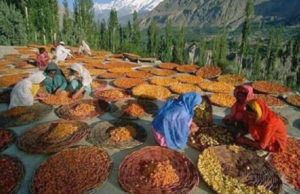
As for the young long-haired guys with Hippie way written on their t-shirts, either true hippies or retro lovers, they mostly eat apricots in Karimabad.
This is undoubtedly the main value of Khunzakut Gardens. The whole of Pakistan knows that only here grow ‘khan fruits’, which flow fragrant juice even on trees.
Hunza is attractive not only for radical youth. this is where lovers of mountain travel and history come,
and those who simply like to climb far from their homeland. Lots of rock climbers complete the picture, of course…
As the valley lies halfway from the Khunjerab Pass to the beginning of the plains of Hindustan, the Khunzakuts believe that they generally control the route to the ‘upper world’. To the mountains, as such.
They speak their own language, Burushaski (Burushaski, whose kinship has not yet been established with any language in the world,
although everyone here knows Urdu and many English), that is, of course, like most Pakistanis, they practice Islam.
But a special belief, that is, Ismaili, one of the most mysterious and mystical of the religion, which is practiced by up to 95% of the population.
Therefore, in Hunza you will not hear the usual calls to prayer rushing from the loudspeakers of the minarets. Everything is calm, prayer is everyone’s personal business and time.
Hunza bathes in cold water even at 15 degrees of frost, plays outdoor games for up to a hundred years, 40-year-old women look like girls, at 60 they maintain their slim and graceful figure,
and at 65 they still give birth to children; In summer they eat raw fruits and vegetables, in winter they eat sun-dried apricots and sprouted grains, sheep’s cheese.
The Hunza River was a natural barrier for the two medieval principalities of Hunza and Nagar. Since the 17th century,
these principalities have been constantly at war, stealing each other’s women and children and selling them into slavery. Both lived in fortified villages.
One more thing is interesting. Among the inhabitants, there is a period when the fruits are not yet ripe, it is called ‘hungry spring’ and it lasts two to four months.
During these months, they eat almost nothing and drink dried apricot drink only once a day. Such a position is elevated to a cult and is strictly observed.